


10th August 2026
By Anjali Kochhar
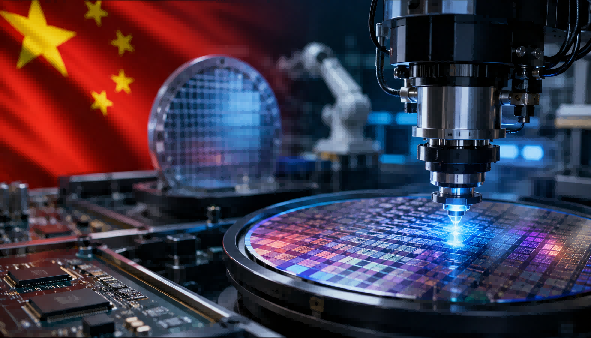
China has announced what it describes as a major breakthrough in semiconductor manufacturing technology, claiming it has developed advanced chipmaking capabilities despite years of Western export restrictions aimed at limiting the country’s access to cutting-edge equipment.
The development marks another step in Beijing’s push for technological self-reliance, particularly in the semiconductor industry, which has become a focal point of geopolitical competition between China and the United States.
China Pushes for Semiconductor Self-Reliance
According to Chinese reports, domestic researchers and manufacturers have successfully advanced chip production technologies that many analysts believed would remain out of China’s reach because of restrictions on advanced lithography equipment. The announcement comes after years of U.S.-led export controls that prevented Chinese companies from acquiring some of the world’s most sophisticated chipmaking tools from overseas suppliers.
How Western Export Controls Target China’s Chip Industry
The restrictions, introduced with support from allies including the Netherlands and Japan, were designed to limit China’s ability to manufacture advanced semiconductors used in artificial intelligence (AI), high-performance computing and military applications. However, Beijing has responded by investing heavily in domestic research and development while encouraging state-backed firms to reduce dependence on foreign technology.
Recent reports indicate that China has begun producing domestically developed immersion deep ultraviolet (DUV) lithography systems, a significant milestone in its efforts to localize semiconductor manufacturing equipment. These machines are expected to be supplied to leading Chinese chipmakers and could reduce reliance on imported tools, although they remain less advanced than the extreme ultraviolet (EUV) systems produced by Dutch giant ASML.
Industry experts caution, however, that the reported breakthrough does not necessarily place China at the forefront of semiconductor manufacturing. While DUV lithography can produce advanced chips through complex multi-patterning techniques, it is generally more expensive and less efficient than EUV technology, which remains the industry standard for producing the world’s most advanced processors. Questions also remain about the performance, production scale and commercial viability of China’s domestically developed equipment.
AI Boom Raises Stakes in the Global Semiconductor Race
The semiconductor race has become increasingly important as AI applications drive global demand for advanced computing power. Countries are investing billions of dollars to strengthen domestic chip production and secure supply chains amid rising geopolitical tensions.
What China’s Chip Progress Means for the Global Tech Race
For China, achieving greater independence in semiconductor manufacturing is viewed as critical to sustaining long-term growth in AI, consumer electronics and strategic industries. While the latest announcement highlights meaningful progress, analysts say the country still faces significant technical and manufacturing challenges before it can fully match the capabilities of leading global semiconductor equipment makers.
